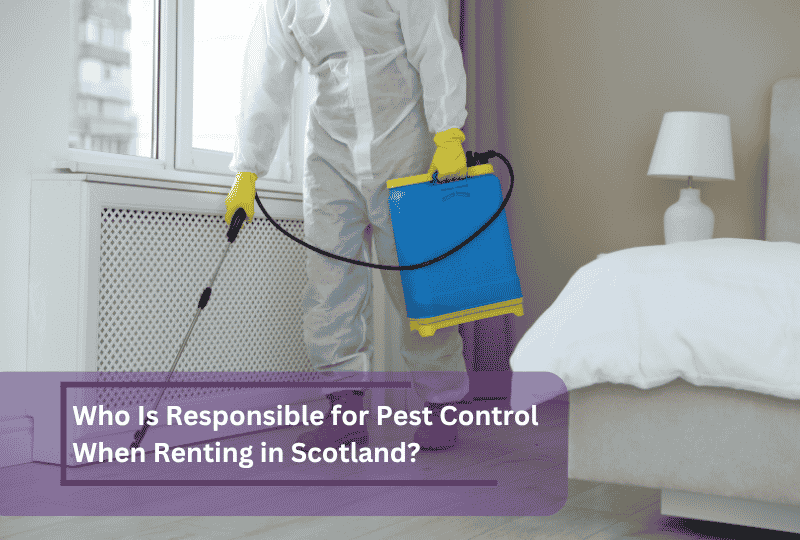
Pest control is one of the more common sources of dispute between landlords and tenants in the private rental sector, and it is not always straightforward to resolve. Pest problems in rental properties are more widespread than many landlords expect, with 47% identifying mouse infestations as their primary issue, rat infestations close behind at 39%, and many having experienced more than one type of pest problem.
Unlike many other property maintenance issues, there is no single rule that determines who is responsible. The answer depends on how the infestation started, what the tenancy agreement says, and whether the property meets its required legal standard.
For landlords in Scotland, understanding where your responsibilities begin and end is important. Not just to resolve disputes fairly, but also to stay compliant with the Repairing Standard and avoid enforcement action from local authorities.
In this guide, you will learn about what the law says about pest control in rental properties, how responsibility is determined in different situations, what steps tenants can take if a landlord fails to act, and where to find pest control support in Dundee.
What the Law Says About Pest Control in Rental Properties
Before you decide who is responsible for pest control in rental properties, it is important to understand the legal framework behind it. In Scotland, six key pieces of legislation cover this area, and knowing them will help you approach any dispute from a much stronger position.
- The Repairing Standard, set out in the Housing (Scotland) Act 2006, requires private landlords to ensure that a rental property meets a minimum standard of repair both at the start of a tenancy and throughout it. If a pest infestation develops as a result of a structural defect, such as a hole in a wall, a broken vent, or a damaged window frame, the landlord is likely in breach of the Repairing Standard.
- The Housing (Scotland) Act 1987 requires that rental properties be fit for human habitation. A serious infestation that makes a property genuinely unpleasant or unsafe to live in can bring this obligation into play.
- The Private Housing (Tenancies) (Scotland) Act 2016 governs tenancies created on or after 1 December 2017. While it does not address pest control directly, it reinforces that landlords must maintain the property to the required standard for the duration of the tenancy.
- The Environmental Protection Act 1990 applies across the UK, including Scotland. Where a pest infestation constitutes a statutory nuisance, meaning it is harmful to health or a serious nuisance to others, the local council has the power to serve an abatement notice on the responsible party.
- The Prevention of Damage by Pests Act 1949 places a duty on local authorities to control mice and rats and provides them with enforcement powers to compel landlords and occupiers to take action where a property is infested.
- The First-tier Tribunal for Scotland (Housing and Property Chamber) is the primary dispute resolution route in Scotland, not the courts. If a tenant believes their property does not meet the repairing standard, they can apply to the Tribunal, which has the power to require landlords to carry out the necessary work.
Understanding these laws helps you approach any dispute from an informed position.
When Is the Landlord Responsible for Pest Control?
It is important to know when pest control is your responsibility as a landlord. There are six situations where the obligation falls firmly on you, and understanding them will help you respond to problems more effectively and protect yourself if a dispute ever arises.
Infestations Present at Move-In
If pests were already in the property before the tenancy began, it is the landlord’s responsibility to resolve them. This rule is particularly clear for furnished properties, but it is widely considered to apply to unfurnished properties as well. This is precisely why a thorough check-in inventory matters so much.
It documents the condition of the property at the point of handover and serves as clear evidence of whether a pest problem existed before the tenant moved in. Without it, establishing when an infestation started becomes much more difficult.
Result of Property Disrepair
Holes in walls, broken air bricks, crumbling skirting boards, damaged roof tiles, and leaking pipes are all entry points and breeding conditions for pests. If your tenant has reported maintenance issues that were left unaddressed, and a pest problem then develops as a result, the responsibility for dealing with it falls on you as the landlord.
Staying on top of repairs is not just good practice; it is one of the most effective ways to prevent infestations from taking hold in the first place.
Contractual Obligations
If your tenancy agreement contains a clause stating that you will keep the property in a habitable or good condition, that obligation is generally broad enough to include pest control.
Even where pest control is not mentioned explicitly, a well-drafted maintenance clause can be enough to establish landlord responsibility. It is worth reviewing your agreement carefully and seeking advice if you are unsure what your contractual duties cover.
Recurring Seasonal Pests
Some pest problems are not random; they are predictable. For example, if your property is in an area where wasps consistently nest year after year, you are expected to have a treatment contract in place rather than waiting for your tenant to flag the problem each summer.
Recurring seasonal pests are a known and foreseeable issue, and failing to address them proactively could be considered a failure to maintain the property to the required standard.
Public Health Risks
A pest infestation that spreads beyond your property boundary becomes a public health concern, and the responsibility for addressing it remains with you as the landlord. Local authorities take a serious view of infestations that affect multiple properties, and failing to act promptly could result in enforcement action from the council.
Failure of Previous Treatments
Your responsibility as a landlord does not end the moment a pest controller leaves the property. A single unsuccessful treatment is not enough. You are expected to follow up, arrange further treatment where needed, and ensure that any structural issues allowing pests to enter are also repaired so the problem does not return.
When Is the Tenant Responsible for Pest Control?
Just as there are situations where pest control is firmly the landlord’s responsibility, there are also situations where the obligation falls on the tenant. There are four common scenarios where this is the case, and tenants should be aware of them to avoid being held liable for costs that could have been prevented.
Poor hygiene or waste management
Tenants have a responsibility to maintain a clean and hygienic living environment, and failing to do so can directly lead to a pest problem. Where an infestation can be traced back to poor waste management, such as leaving food out, not taking bins out regularly, or allowing rubbish to build up inside or outside the property, the cost of treatment falls on the tenant rather than the landlord.
Tenant-Induced Damage
Pest problems are not always the result of neglect. A tenant who has broken a vent cover, damaged a door seal, or made alterations to the property that inadvertently created entry points for pests can be held responsible for any infestation that follows. In these cases, the crucial question is whether the tenant’s actions created the entry point or if it existed before the tenancy.
Failure to Report Promptly
Tenants have a responsibility to report signs of a pest problem as soon as they become aware of them. Droppings, gnaw marks, unusual sounds in the walls, or damage to food packaging are all early warning signs that should be immediately reported to the landlord. Where a tenant delays reporting, and the infestation spreads as a result, they may be held liable for the additional damage and the increased cost of treatment.
Pests Introduced by Tenant
Not all infestations are caused by the condition of the property. For example, bedbugs are almost always introduced through a person or their belongings rather than through any fault with the property itself. Where a pest problem can be directly linked to what a tenant has brought into the property, the responsibility for resolving it and covering the cost of treatment falls on them rather than the landlord.
When Is Responsibility Shared Between Landlord and Tenant?
Not every pest control situation falls neatly into the landlord’s or the tenant’s court. There are cases where responsibility is genuinely shared or where neither party is directly at fault, and these tend to be the most difficult disputes to resolve. There are two common scenarios where this is the case.
Pests Migrating from a Neighbouring Property
Where the source of an infestation is a neighbouring property, neither the landlord nor the tenant caused the problem; resolving it may require cooperation with neighbours or involvement from the local council. In these cases, it is worth contacting your local environmental health team early, as they have the authority to investigate and take action when a neighbouring infestation is affecting multiple properties.
No Pest Control Clause in the Tenancy Agreement
Where a tenancy agreement contains no specific clause on pest control, and it is genuinely unclear whether the infestation was caused by a maintenance failure or the tenant’s behaviour, both parties may need to come to a mutual agreement.
In this situation, the most sensible approach is usually for the landlord to arrange treatment first and then assess the evidence to determine whether the cost should be recovered from the tenant’s deposit.
Note: In unclear situations, it is almost always better for the landlord to act first and establish the facts afterwards than to leave the problem unresolved while a dispute plays out. Delays rarely help either party, and in some cases, they can make the landlord liable for additional damage that could have been avoided with prompt action.
What Counts as Evidence?
When a pest control dispute arises, having the right documentation in place can make all the difference. Here is what both landlords and tenants should keep on record:
- A signed check-in inventory that confirms the property was pest-free at the start of the tenancy.
- A check-out inventory documenting the condition of the property when the tenant leaves, which can support a deposit deduction claim if pest damage is found.
- Records of any maintenance issues reported by the tenant and the landlord’s response to them.
- Mid-tenancy inspection reports with dates, as these show the condition of the property throughout the tenancy, not just at the beginning and end.
- Written reports of any pest sightings should be sent by email or text, so there is a clear timestamp.
- Photographs of any evidence of pests, including droppings, gnaw marks, or damage to the property.
- Receipts and reports from any pest control treatments that were carried out.
The more thorough your records are, the easier it becomes to establish the facts quickly and reach a fair outcome without the dispute escalating further.
Does Landlord Insurance Cover Pest Infestations?
In most cases, standard landlord insurance does not cover pest infestations. Most landlord insurance policies exclude damage caused by insects and vermin. This means that if rats chew through electrical cables or mice damage insulation in your rental property, you will typically need to cover both the pest treatment and the resulting repair costs yourself unless you have a specific add-on or a home emergency cover policy.
There are exceptions worth knowing about. Some insurers will cover the cost of removing wasp or bee nests, often up to a capped amount, and home emergency cover, which can often be added to a standard policy for a modest monthly cost, is more likely to include pest-related callouts.
If you are unsure what your current policy covers, it is worth reviewing it carefully and speaking to your insurer directly before a pest problem arises rather than after.
What to Do If a Landlord Will Not Deal With Pests
If a tenant has reported a pest problem and the landlord is not responding or refusing to take action, there are clear steps that can be taken. Landlords should know this process, as it shows what they could face if they don’t act quickly.
Step 1: Report the Problem in Writing
The tenant should put the problem in writing. If the tenant has only raised the issue verbally, they should immediately follow up in writing, including photographs where possible. This creates a dated record of the report and gives the landlord clear notice of the problem.
Step 2: Provide the Landlord a Reasonable Time to Respond
A week to ten days is generally considered a reasonable window for a landlord to at least acknowledge the issue and set out a plan. What counts as reasonable will depend on the severity of the problem, as a rat infestation warrants a faster response than a seasonal ant problem.
Step 3: Contact the Local Council’s Environmental Health Team
Where the landlord has not responded or refuses to act, the tenant can contact the Environmental Health Department at their local council. They have the power to inspect the property and serve the landlord with an enforcement notice requiring them to address the problem within a fixed timeframe.
Step 4: Understand What Happens If the Landlord Ignores the Enforcement Notice
A landlord who fails to comply with an enforcement notice can have the treatment arranged by the council, with all costs, including administration fees, recovered directly from them. In serious cases, a property that falls below minimum living standards can be ordered closed until the issue is resolved.
Step 5: Consider a compensation claim
Tenants who have suffered financially as a result of the infestation, through damaged belongings, hotel costs during fumigation, or loss of enjoyment of the home, may be entitled to compensation from the landlord.
Note: Tenants should not stop paying rent in protest. Withholding rent can be grounds for eviction and will undermine their position in any formal dispute.
Is There a Time Limit for Removing Pests from a Rental Property?
There is no single fixed legal deadline that applies to every situation, but the law does expect prompt action.
Under the Housing (Scotland) Act 2006 and the Repairing Standard, if an infestation is found to be the landlord’s responsibility, they are required to take steps to remove it as soon as possible. The severity of the infestation, the availability of pest control contractors, and the need for structural repairs will determine the timeframe.
If a council serves a formal enforcement notice on a landlord following an inspection, that notice will typically specify a fixed timeframe within which the landlord must act. Failing to comply within that window exposes the landlord to fines.
How to Prevent Pest Infestations: Tips for Landlords and Tenants
Both landlords and tenants have a role to play in keeping a property pest-free. While dealing with an infestation after it has taken hold can be costly and stressful for both parties, many pest problems can be avoided entirely with the right preventive measures in place. Here are the most practical steps each party can take to reduce the risk.
Tips for Landlords
- Regularly inspect the property for potential entry points, including cracks in external walls, missing or damaged roof tiles, gaps around pipes, and broken air bricks or vents.
- Seal any entry points as soon as they are identified, as this is far cheaper than treating an infestation after the fact.
- Fix leaking pipes promptly, as damp conditions attract a wide range of pests.
- Put a seasonal treatment contract in place for properties in areas prone to recurring pests, such as wasps, rather than waiting for tenants to raise the problem each year.
- Include simple guidance on pest prevention in the welcome pack at the start of the tenancy, covering waste disposal, food storage, and what to do if the tenant notices early signs of a problem.
- Carry out regular mid-tenancy inspections so that early signs of an infestation can be caught and addressed before they escalate.
Tips for Tenants
- Store food in sealed containers and avoid leaving food out on surfaces.
- Take bins out regularly and avoid allowing rubbish to accumulate inside or outside the property.
- Report any signs of pests to the landlord as soon as they are noticed, including droppings, gnaw marks, unusual sounds in the walls, or damage to food packaging.
- Keep the property clean and well-maintained to avoid creating conditions that attract pests.
- Report any damage to vents, door seals, or other structural elements promptly, as these can create entry points for pests if left unaddressed.
Pest Control Options in Dundee
If you are a landlord or tenant in Dundee dealing with a pest problem, you have several options available to you.
| Pest Type | Common Treatment | Estimated Cost | Who’s Typically Responsible |
| Mice / Rats | Traps, bait stations, proofing | £100–£300 | Landlord (if structural entry point) / Shared |
| Cockroaches | Chemical or eco spray treatment | £100–£250 | Usually landlord |
| Bedbugs | Heat treatment + Chemical | £300–£600 | Depends on the cause |
| Wasps / Bees | Nest removal or treatment | £50–£150 | Usually landlord |
| Ants | Chemical treatment | £75–£150 | Usually, the tenant (hygiene-related) |
| Moths | Fumigation + prevention advice | £100–£200 | Usually tenant |
| General Prevention | Quarterly treatment contract | £60–£120 per visit | Landlord (recommended) |
Note: Costs are approximate and will vary depending on the property size, severity of the infestation, and the contractor you use.
Conclusion
Pest problems in rental properties are rarely straightforward, which is exactly why disputes between landlords and tenants happen so often. In some cases, the landlord is clearly responsible, especially when the infestation is linked to structural issues or maintenance problems. In others, the tenant may be responsible if poor hygiene, waste management, or damage to the property caused the issue.
The key thing for both sides is to act early. Most infestations become far more expensive and stressful when they are ignored for too long. Reporting problems quickly, keeping written records, and dealing with repairs or treatment promptly can prevent a small issue from turning into a serious dispute.
If you are a landlord in Dundee and want help managing repairs, maintenance, inspections, and tenant issues more effectively, Westport Property is here to help. With over 13 years of experience in property management, our team has the knowledge and expertise to keep your rental property protected year-round. Get in touch with us today to find out more about our property management services.
Have A Question or Need Some Help?
Whether you're searching for the perfect rental property or a landlord wanting advice on letting, we're here to assist. Feel free to call our office or send us an email, and we'll be happy to help you with any queries you may have.
Frequently Asked Questions
Is it the landlord's responsibility to get rid of mice?
Usually, yes. If mice have entered through a structural defect, including a gap in a wall, a broken air brick, or a hole around a pipe, the landlord is responsible for both the repair and the treatment. If the infestation was caused by the tenant's poor waste management or hygiene, the tenant is responsible.
What is the hardest pest to get rid of?
Bedbugs are the hardest to get rid of as they hide in mattress seams, skirting boards, and electrical sockets, can survive for months without feeding, and are increasingly resistant to chemical treatments. Effective removal usually requires professional heat treatment combined with chemical application across multiple visits.
How to ask a landlord to pay for pest control?
Put it in writing, describe what you have found, where, and when, and include photographs. State clearly why you believe it is the landlord's responsibility. Give them seven to ten days to respond. If they do not act, contact Dundee City Council's Environmental Health team, who can inspect the property and issue a formal notice if needed.
 Find a Property Sale/Rent
  Property Management
  Tenant Background Screening
  Rent Collection
  Property Maintainance
  Property Inspection
  Property Advertising
  Portfolio Management For Landlords
  Investment & Asset Management